

Dev log · · v0.44.1
In a blow: less heel, a deep bang, softer rain
Reefing works now: in 18 to 25 knots the boat sails at 15 to 20 degrees of heel instead of 25 to 30, with weather helm and a round-up if you leave the sheets cleated. The boom slams with a real bang, and the rain no longer clicks.
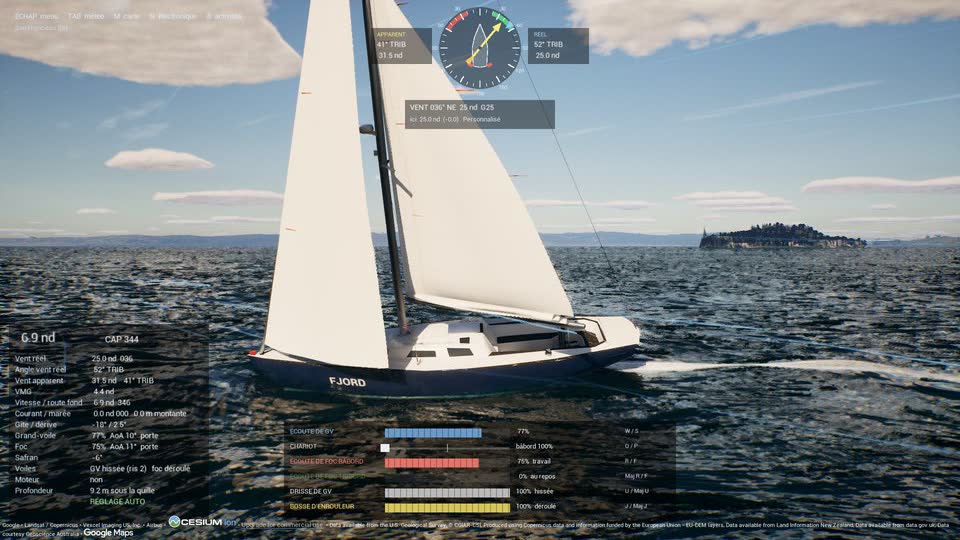
The last time we wrote about the water, we said the boat heeled too much in strong wind, even reefed. That is fixed. While we were out in the weather, we also redid two sounds that did not sound like a boat: the boom hitting its stop, and the rain.
The heel
The righting side was right: the hull and its lead keel give the stability the builder’s figures say they should. The fault was on the heeling side.
- The sails kept their full draft at any wind speed, so the force on them stayed high up the mast.
- The automatic trim only eased the main. The jib stayed powered up, so a reefed boat still carried most of its power forward, and reefing barely changed the heel.
What changed (version 0.35.2, in the main game since 0.36.1):
- The crew flattens the sails. From about 14 to 26 knots of apparent wind, the sails get flatter and twist off at the top, the way you would with the backstay, outhaul and cunningham. That cuts their lift to about two thirds and brings the force lower. Light air is unchanged.
- Auto-trim depowers in order from 15 degrees of heel, and reacts early when a gust starts to lay her over: first the traveller down, then the main eased until it luffs, then the jib.
- Weather helm. A heeled hull now wants to turn into the wind, as the lee bow digs in. Expect 4 to 7 degrees of helm at 18 to 21 degrees of heel. Leave the sheets cleated in a gust and the rudder runs out of grip and she rounds up.
- Reefs are smaller. The reefed main also loses some foot, so it is 77% and 57% of the full sail, not 80% and 62%.
- The keel’s weight sits a bit lower, for about 6% more righting moment.
- The sails look it: an eased main backwinds at the luff, and the sails look flatter and more twisted in a breeze.
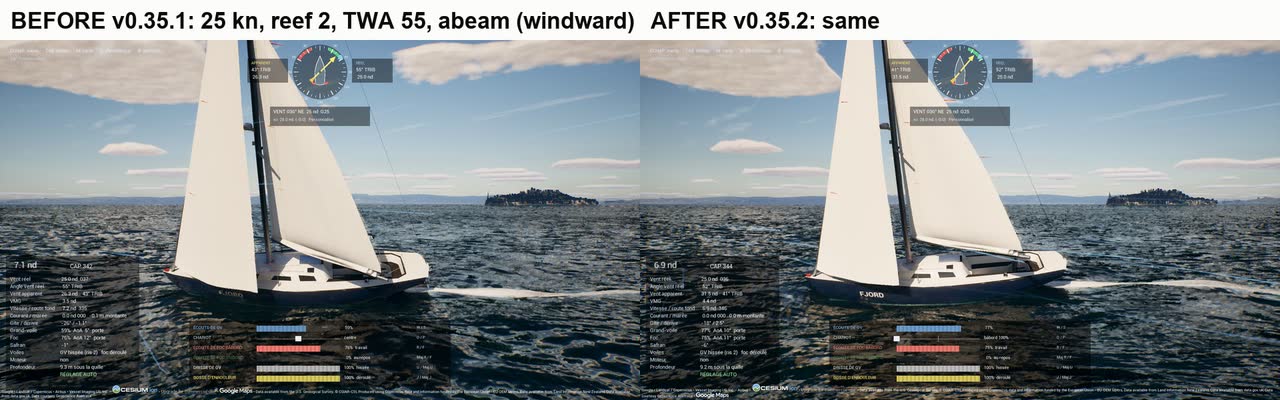
Steady heel with auto-trim, close-hauled (42 degrees off the true wind), before and after:
| Sails | 10 kn | 18 kn | 25 kn | 30 kn |
|---|---|---|---|---|
| Full | 20.3° → 17.8° | 26.6° → 20.1° | 33.0° → 21.1° | 37.4° → 21.7° |
| One reef | 17.5° → 15.6° | 25.9° → 19.3° | 31.1° → 20.7° | 35.4° → 21.4° |
| Two reefs | 13.9° → 12.2° | 25.0° → 18.4° | 29.7° → 20.1° | 34.0° → 21.0° |
| Two reefs, jib at 60% | 9.6° → 8.3° | 22.5° → 16.4° | 26.1° → 19.0° | 28.3° → 20.1° |
In a gust from 16 to 27 knots under full sail, auto-trim now keeps her under 22 degrees; it used to let her go to 35. With the sheets cleated, she heels to 33 degrees, the rudder goes hard over and she rounds up from 55 to 37 degrees off the wind.
Upwind in a breeze she is about 0.3 knots slower, because she now sails at 20 degrees of heel rather than 27. Reaching and downwind speeds are the same.
The boom
When the boom or the jib reached the end of its travel, the old sound was a light knock under a burst of hiss. It sounded like a plastic bag. Now it plays recorded impact sounds, a deep metal-and-wood bang, chosen by how fast the boom arrives (version 0.44.1):
- A soft bump plays the deep body of the hit alone, quieter and muffled.
- A crash gybe plays the full bang at full level, pitched down a little.
- The jib is lighter, quieter and pitched up.
- Every hit varies a little in pitch and level, so repeats do not sound the same.
- Softer arrivals are heard too: from 15 degrees a second, where only arrivals above 60 used to make a sound. The small bounces right after a hit are dropped.
- The sound comes from the boom itself. It is full within 20 m and fades over 300 m, so you still hear it from the shore camera. It follows the Wind, water and boat volume slider.
In our test runs, a tack makes two soft stops and a gybe by the lee makes four. Heading into the wind makes none.
The rain
The old rain was a white hiss with sharp pings on top, closer to a Geiger counter than a shower. The new rain (version 0.43.0) is made of:
- a soft hiss on the water that rises and falls slowly;
- a dense patter of tiny taps through the hollow deck and the canvas;
- many soft, low drops, each a little different, with no sharp clicks;
- now and then a heavier drip off the rig and the boom.
It follows the rain’s intensity. When the camera moves away from the boat, the deck sounds fade first and the whole wash gets darker and quieter.